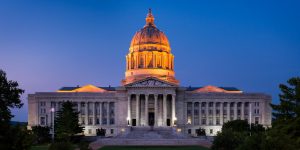
The 2026 Missouri legislative session officially ended on Friday, May 15th, concluding the second regular session of the 103rd General Assembly. Republicans maintain supermajorities in both chambers’ legislative chambers with a 24-10 Republican majority in the Missouri Senate and a 106-52 Republican majority in the Missouri House of Representatives, with five House vacancies. The session also marked a significant transition period within the General Assembly, as nine Missouri State Senators are term-limited and unable to seek re-election in 2026, representing more than half of the 17 Senate seats up for election next year. Additionally, 32 members of the Missouri House are term-limited, ensuring substantial turnover in both chambers heading into the 2027 legislative session.
After 18 weeks of legislative activity, lawmakers filed approximately 3,150 bills during the session. Of those measures, 101 bills — including 17 appropriation bills — were Truly Agreed to and Finally Passed (TAFP’d), surpassing last year’s total of 69 enacted bills. A full list of TAFP’d legislation from the 2026 session may be found here.
The overall tone of the 2026 session differed significantly from the 2025 session, which you might recall ended amid heightened partisan confrontation. This year, lawmakers focused more heavily on the following key priorities and issues:
- Income tax phase out efforts Property tax reform
- Public safety and crime legislation
- Elections
- Banking and Financial Institutions
- Workforce and economic development initiatives
- Infrastructure and transportation investments
- Education and workforce training policy
- Health care access initiatives
One of Governor Mike Kehoe’s signature priorities throughout session was advancing a long-term phase out of Missouri’s individual income tax, which lawmakers ultimately approved through a proposed constitutional amendment now headed to Missouri voters for consideration. Governor Kehoe described the proposal as a transformational economic development initiative designed to increase Missouri’s competitiveness, attract business investment, and allow Missourians to keep more of their earnings. This issue will be placed on the ballot for Missouri voters this year and if passed, will require the legislature to pass statutory language on how to implement and create a new tax base using a broad sales tax on goods and services.
In addition to the income tax proposal, lawmakers also approved several other major priorities during session, including passage of the ICCA hemp regulatory framework legislation, multiple public safety initiatives, workforce development investments, and several economic development measures highlighted by the Governor and legislative leadership as major wins of the 2026 session. While several proposals gained momentum throughout session, others continued to face challenges navigating the legislative process. Two of the highest-profile priorities that ultimately failed to cross the finish line were legislation authorizing Video Lottery Terminals (VLTs) and efforts to reform the state property tax assessment process.
The Governor will receive all bills passed on May 30th and then decide whether to sign, veto or pocket vet the various policies and appropriation bills sent to his desk. Appropriation decisions must be finalized by June 30, while policy legislation decisions must be completed by July 15. Bills signed by the Governor will generally become effective on August 28, 2026, unless passed with an emergency clause.
Legislators will now return to their districts for the interim before bill filing officially resumes later this year ahead of the 2027 legislative session.
As usual, you will find our detailed report below on all bills of interest that have passed and those that have failed. If you would like a copy of any of the bills that have reached the Governor’s desk, please let us know.
Dates of Interest
June 30, 2026 – Last day for Governor to sign State Appropriation bills
July 1, 2026 – First day of the 2027 State Fiscal Year
July 15, 2026 – Last day for Governor to sign bills
August 4, 2026 – Primary Election
September 16, 2026 – Veto Session
November 3, 2026 – General Election
December 1, 2026 – Pre-filing of bills for 2027 Legislative Session
Budget Update
One of the Legislature’s primary constitutional responsibilities during session remained passage of the Fiscal Year 2027 state operating budget before the constitutional May 8 deadline. This year, both the Missouri House and Senate approved the final conference committee versions of the appropriations bills totaling approximately $50.7 billion, officially completing work on the budget package ahead of the deadline and sending all 17 appropriations bills to Governor Mike Kehoe for consideration. The Governor now has authority to sign the budget bills into law, issue line-item vetoes, or reduce specific appropriations before the FY 2027 budget takes effect July 1, 2026.
Budget negotiations throughout session focused heavily on balancing continued investments in infrastructure, workforce development, public safety, higher education, and economic development initiatives while addressing growing concerns surrounding long-term state revenues and a tightening fiscal environment compared to recent surplus years. Debate in both chambers centered heavily around K-12 education funding levels, with several lawmakers voicing concerns that the state did not fully fund the statutory foundation formula despite maintaining record overall education spending levels. House budget leaders defended the final agreement by emphasizing that education funding remains historically high while acknowledging the Legislature must begin preparing for slower revenue growth and more restrained future budgets.
In higher education, lawmakers approved House Bill 2003, which funds Missouri’s colleges, universities, and workforce development programs. Senate debate focused heavily on whether Missouri should eventually transition to a revised higher education funding model tied more closely to enrollment and performance metrics. Ultimately, lawmakers-maintained Governor Kehoe’s recommended core funding structure for public institutions while directing continued review of long-term funding formulas. The final budget also included continued investments into workforce training and career readiness programs, including funding for the MOScholars education savings account program and various workforce recruitment and retention initiatives championed by the Governor and legislative leadership.
Lawmakers additionally finalized capital improvement and maintenance appropriations through House Bills 2017, 2018, 2019 and 2020 (comprised of $2 billion of the $50.7 billion budget) which included funding for statewide infrastructure projects, higher education facility improvements, transportation investments, economic development initiatives, and numerous community-based projects across Missouri. The capitol improvements budget included $15M for a new conference center and parking garage in Jefferson City to help address some of the current parking challenges in the capitol city. Compared to the 2025 session — where lawmakers nearly faced the possibility of a special session to complete budget work and tensions escalated following the collapse of a major capital improvements bill — this year’s appropriations process was viewed as significantly smoother and more coordinated between both chambers.